Exploring the hills above Saint-Joseph from La Belle du Sud
La Plaine des Grègues: discovering Réunion Island’s turmeric village
High above Saint-Joseph, sheltered by steep green mountains, La Plaine des Grègues has grown Curcuma Péi for generations. The drive from La Belle du Sud leaves the coast behind and reveals a rural village shaped by farming, family knowledge and one of the defining flavours of Réunionese cooking.
On Réunion Island, a short drive can carry you into an entirely different landscape.
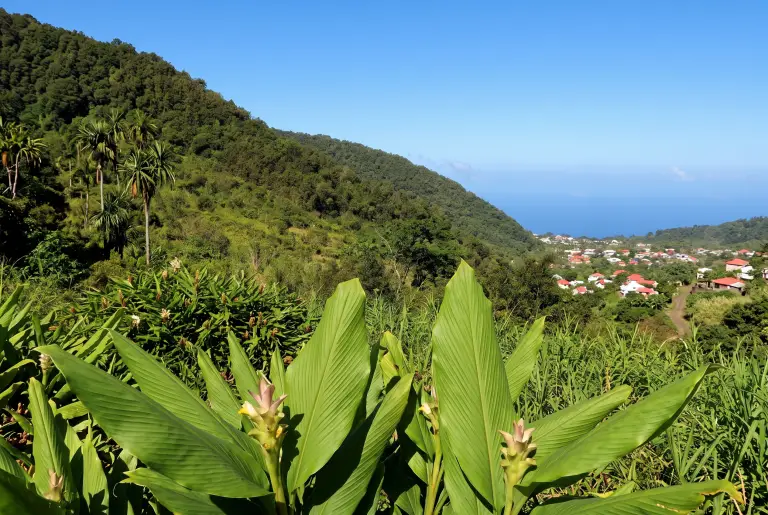
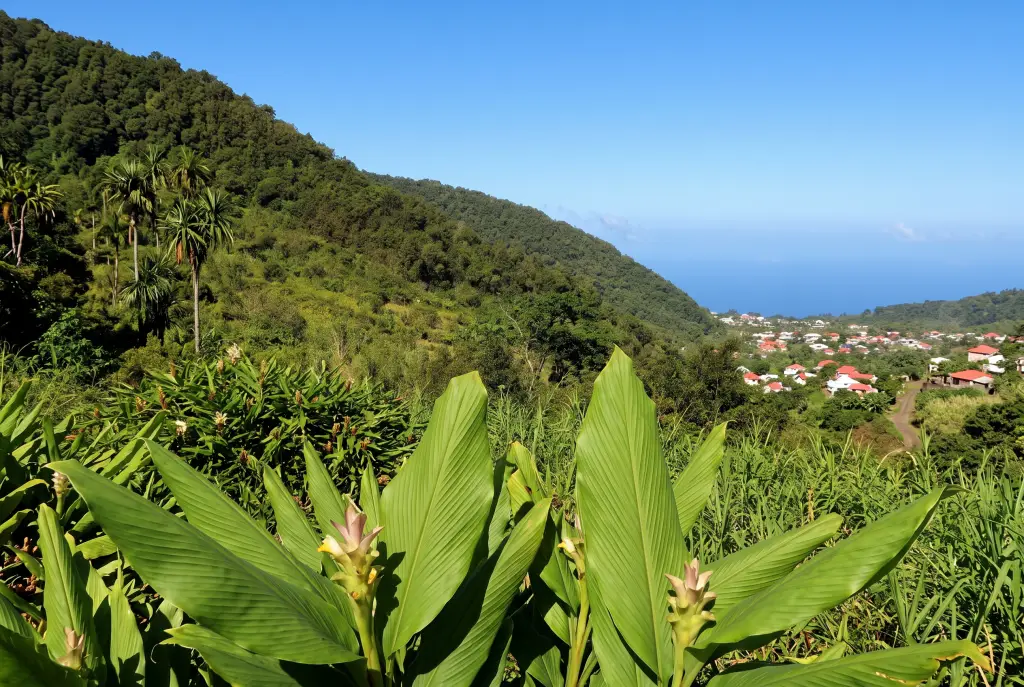
As you leave La Belle du Sud , the Indian Ocean remains close at first. The road then begins to climb above Saint-Joseph. Houses grow fewer, the air becomes cooler and the mountains draw in around you.
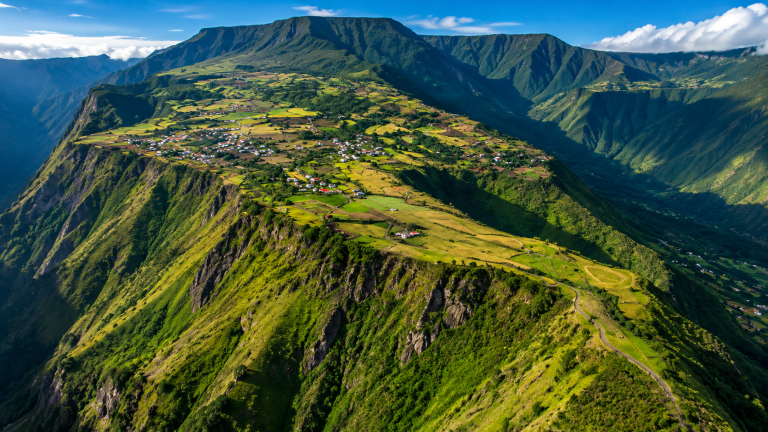
At the top lies La Plaine des Grègues, a farming village set inside a vast natural amphitheatre. Small roads wind between Creole homes, gardens and cultivated plots.
The crop that made the village famous is mostly hidden from view. It grows beneath the soil: Curcuma Péi, more commonly known on the island as Safran Péi.
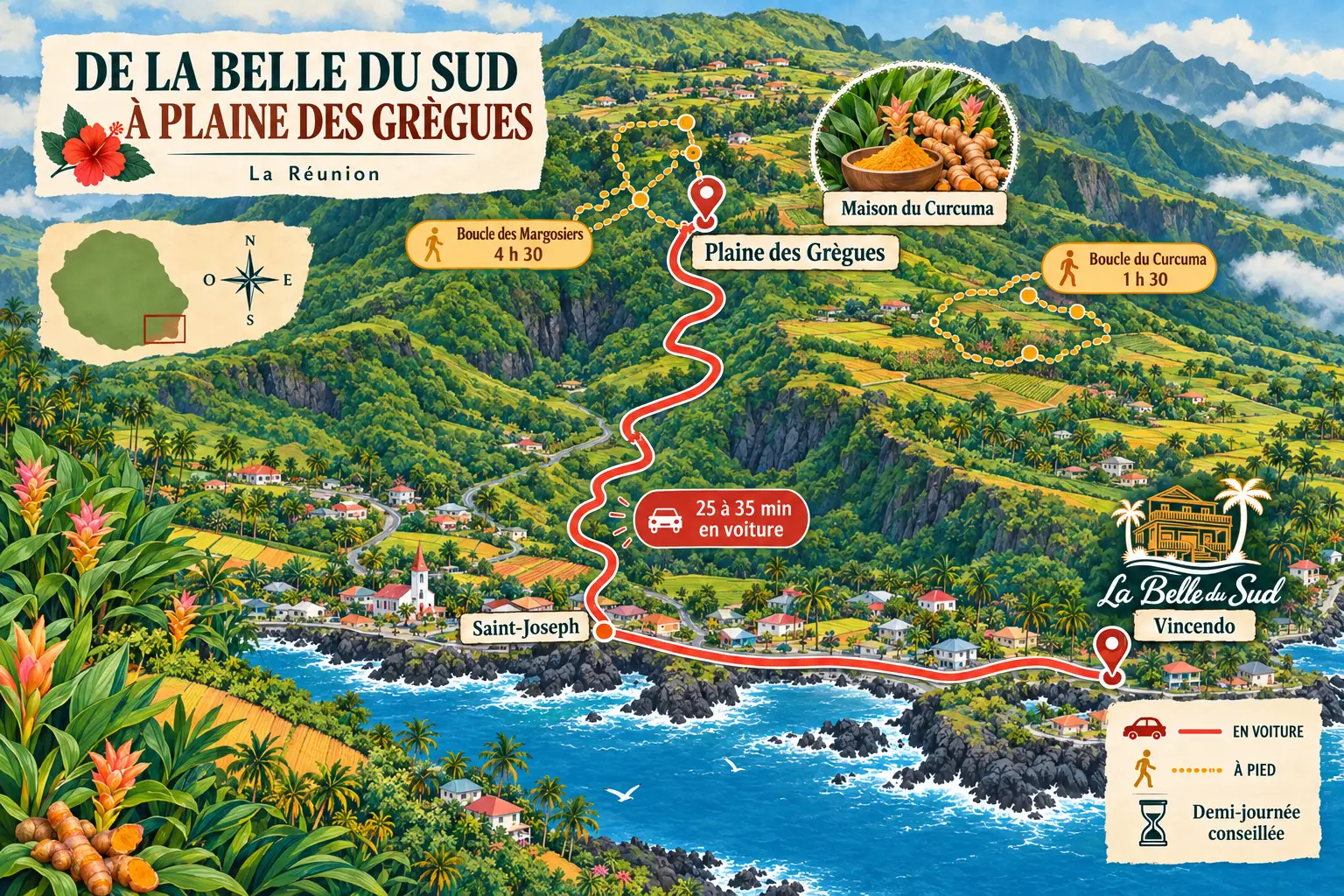
La Plaine des Grègues from La Belle du Sud: essential information
| Information | What you need to know |
|---|---|
| Destination | La Plaine des Grègues, Réunion Island’s turmeric village |
| Municipality | Saint-Joseph, in the south of the island |
| From La Belle du Sud | Approximately 25 to 35 minutes by car, depending on traffic and route |
| Recommended visit | Half a day for the village and the Maison du Curcuma |
| For hikers | A full day for the more demanding Margosiers loop |
| Highlights | Creole village life, farmland, Curcuma Péi and mountain scenery |
| What to bring | Comfortable shoes, water, sun protection and a light rain jacket |
| Before leaving | Check the current opening and visiting times |
Where is La Plaine des Grègues?
La Plaine des Grègues belongs to the municipality of Saint-Joseph. It lies inland, above the town centre and well away from the main coastal road.
Its setting is part of its appeal. The village occupies a natural basin encircled by steep, densely planted slopes. It is often described as a small cirque. Viewed from the higher paths, the comparison immediately makes sense.
The mountains form a green amphitheatre around houses, gardens, fields and pasture. Narrow lanes follow the contours of the land, opening every so often onto broad views across the village.
The mood is very different from Vincendo. At La Belle du Sud , the eye is naturally drawn towards the Indian Ocean. In La Plaine des Grègues, the mountains take over. Fields rise towards the ridges and clouds drift across the high ground.
Yet the coast is never far away. You can leave after breakfast, spend the morning exploring the village and return to Vincendo during the afternoon.
Why is La Plaine des Grègues known as the turmeric village?
La Plaine des Grègues is widely regarded as Réunion Island’s turmeric capital. The name reflects a living agricultural tradition rather than a label created for visitors.
The cooler, damper climate of the hills suits the plant. Above ground, turmeric produces long green leaves. The valuable part develops out of sight beneath the soil.
This is the rhizome, a knotted underground stem that resembles ginger. Cut it open and it reveals an intense orange centre.
Across Réunion Island, turmeric is usually called Safran Péi. Despite the name, it is not the same as true saffron. Turmeric comes from a rhizome; saffron is harvested from the stigmas of a flower.
“Péi” signals its local roots. It describes something grown here, connected to the island and embedded in everyday Réunionese cooking.
In La Plaine des Grègues, turmeric begins its story beneath the earth before lending its colour to kitchens across the island.
How is Curcuma Péi grown?
The process begins with sections of carefully selected rhizomes. These are planted in prepared soil and allowed to sprout.
Over the following months, leaves rise above ground while new rhizomes develop below. When the foliage turns yellow and begins to dry, the crop is approaching maturity.
The rhizomes are dug out, sorted and thoroughly cleaned. Processing then begins. Depending on the method, they may be cooked or blanched before being cut into pieces and left to dry.
During the season, orange turmeric can sometimes be seen drying in courtyards or beside village homes. It is one of the details that makes the agricultural calendar visible in everyday life.
Only once the turmeric is fully dry can it be ground. A modest amount of powder represents months of growth and many hours of careful work.
- Planting: pieces of selected rhizome are placed in prepared soil.
- Growth: leaves develop above ground as new rhizomes form below.
- Harvest: the rhizomes are lifted once the foliage reaches the end of its cycle.
- Cleaning: soil and damaged sections are carefully removed.
- Drying: the prepared turmeric is dried until its moisture has gone.
- Grinding: the dried pieces are finally turned into powder.
Turmeric in Réunionese cooking
In a Réunionese kitchen, turmeric rarely needs an introduction. A small spoonful brings warmth of colour and a gentle, earthy note.
It appears in selected caris, vegetable dishes, yellow rice and zembrocal. Rather than dominating a dish, it works alongside garlic, onion, ginger, thyme and the other flavours that shape Creole cooking.
Fresh turmeric can also be grated or made into a paste. Its colour is remarkably persistent, however, and will readily stain fingers, chopping boards and pale fabrics.
This respect for local produce and island flavours can also be found at the table d’hôtes at La Belle du Sud , offered on Mondays, Wednesdays and Fridays with advance booking.
Visiting the Maison du Curcuma
The Maison du Curcuma is one of the best-known places to visit in La Plaine des Grègues. Mémé Rivière and her family share the story of Safran Péi and explain how a freshly harvested rhizome becomes the powder used in local kitchens.
Depending on the visit, the experience may include a short film, explanations of the processing stages, time in the private garden and an introduction to other spices used on Réunion Island.
The shop offers a selection of turmeric products and other local flavours.
What can you see and do in La Plaine des Grègues?
The village rewards an unhurried visit. Drive slowly and notice the Creole houses, gardens and small farms along the road.
La Plaine des Grègues is first and foremost a place where people live and work. Fields, courtyards and drying areas often stand on private property, so visitors should explore with consideration.
| Experience | Best suited to | Time required |
|---|---|---|
| Explore the village | A gentle walk through a rural Creole landscape | 1 to 2 hours |
| Visit the Maison du Curcuma | Understanding how Safran Péi is grown and processed | Depends on the visit |
| Walk the Curcuma loop | Visitors looking for a shorter village walk | Approximately 1 hour 30 minutes |
| Hike the Margosiers loop | Fit, experienced and properly equipped walkers | Approximately 4 hours 30 minutes |
| Buy Curcuma Péi | Travellers looking for an edible local souvenir | A few minutes |
The Curcuma loop: a shorter walk through the village
The Curcuma loop offers a way to explore on foot without committing to a full mountain hike.
Taking roughly an hour and a half, it passes through parts of La Plaine des Grègues and its farming landscape. The appeal lies in the atmosphere of the village, its fields and vegetation rather than in a succession of dramatic viewpoints.
It fits easily into a half-day combining the Maison du Curcuma, a walk and a few quiet stops along the way.
Rain can make the earth slippery, even on a modest route. Shoes with a reliable grip are preferable to ordinary town footwear.
The Margosiers loop: a more demanding mountain hike
The Margosiers loop is intended for experienced walkers. The route covers approximately 11 kilometres, climbs close to 900 metres and generally takes around four and a half hours.
It moves between the village, turmeric fields, forest and steep ascents. A good level of fitness is essential.
The effort is rewarded with views over La Plaine des Grègues, the Rivière des Remparts and, on certain stretches, Grand Coude and the landscapes of the south.
Set off early, check the weather and carry enough water. If the paths are waterlogged or the ridges hidden by low cloud, choose another day.
When is the best time to visit La Plaine des Grègues?
The village can be visited throughout the year, although its appearance changes with the seasons and the agricultural calendar.
During the austral winter, cooler temperatures often make walking more comfortable. A light jacket and rain protection are still worth carrying.
Harvesting and drying periods make the work surrounding turmeric more visible. Exact dates vary between fields and producers and are also influenced by the weather.
The village hosts events devoted to Safran Péi. These are lively times to visit, although traffic and visitor numbers naturally increase.
A half-day itinerary from La Belle du Sud
- After breakfast: leave La Belle du Sud and travel through Saint-Joseph towards the hills.
- Arrive in La Plaine des Grègues: take a first look around the village and its farmland.
- Discover Curcuma Péi: join a pre-arranged visit or browse local products when available.
- Continue on foot: follow the Curcuma loop or take a gentle walk through the village.
- Return to Vincendo: descend towards the coast and enjoy a quiet afternoon at La Belle du Sud.
What else can you discover around La Plaine des Grègues?
The farming landscapes of the hills complement the other experiences available from La Belle du Sud.
The journey to Grand Galet Waterfall and the Langevin River follows water through tropical scenery, natural pools and steep green valleys.
For a return to the ocean, the Cap Jaune trail leads towards striking ochre cliffs shaped by volcanic activity and the sea.
The lava tunnels of the Sud Sauvage reveal the island’s volcanic story from below the surface.
Finally, the open landscapes of Piton de la Fournaise offer a dramatic contrast to the cultivated green slopes of La Plaine des Grègues.
Why visit La Plaine des Grègues from La Belle du Sud?
La Plaine des Grègues reveals a quieter, more intimate side of Réunion Island. Its character lies in the surrounding landscape, its crops and the knowledge passed down through generations.
The journey from Vincendo is short enough to fit comfortably into a stay in the Sud Sauvage. It particularly suits travellers who want to understand the island as well as photograph it.
On the return journey, the Indian Ocean gradually reappears beyond the hills. Before long, you are back at La Belle du Sud, where the pool, veranda and tropical garden are waiting.
There may be a packet of Curcuma Péi in your bag. Later, when a pinch of it colours a meal, the village will return to mind.
FAQ – Visiting La Plaine des Grègues
Where is La Plaine des Grègues?
La Plaine des Grègues lies in the hills of the Saint-Joseph municipality in southern Réunion Island. The village sits in a natural basin surrounded by green mountain slopes.
How long does it take from La Belle du Sud?
Allow approximately 25 to 35 minutes by car from La Belle du Sud in Vincendo, depending on traffic and the route taken.
Why is La Plaine des Grègues famous?
The village is renowned for growing and processing Curcuma Péi, commonly known on Réunion Island as Safran Péi.
Are turmeric and saffron the same spice?
No. Turmeric is produced from a rhizome, while true saffron comes from the stigmas of a flower. Turmeric is nevertheless traditionally called Safran Péi on Réunion Island.
Can you visit the Maison du Curcuma?
Visits take place at specific times. Current tourism information lists guided visits on Thursday mornings. Check the latest arrangements directly before travelling.
How much time should you allow?
Half a day is sufficient for the village, the story of turmeric and a short walk. Allow a full day for the Margosiers loop.
Is the Margosiers loop difficult?
Yes. The hike covers approximately 11 kilometres and almost 900 metres of elevation gain. It is intended for fit and properly equipped walkers.
Can you buy Curcuma Péi in the village?
Yes. Depending on opening times and availability, turmeric and other spice products are sold at the Maison du Curcuma and elsewhere in the village.
In La Plaine des Grègues, the village’s treasure grows beneath the soil.
Sunshine, patience and generations of knowledge eventually bring its colour into the light.